

Mind & Body
Best Skiing Exercises: Power-Up Your Early Ski Season Fitness
Photo: Jack Michael catching freshies.
Skiing Exercises to Avoid Injuries and Get in Shape for the Season
It’s never too late to add training to your early season preparation. With ski and snowboard season on the horizon, you may be wondering what you skiing exercises you can do to make those first few turns of the season a safer and more enjoyable experience.
Aspen Valley Health physical therapist and former ski patroller, Jack Michael PT, DPT tells you how by sharing his expertise with some tried-and-true skiing exercises and steps you can take to both avoid injuries and make your on-hill experience as enjoyable as possible.
Why is it important for people to get in shape for ski and snowboard season?
First and foremost, being in better shape reduces your risk of injury, especially as the day goes on when fatigue would normally set in. Additionally, regularly performing skiing exercises will help you experience less soreness and pain after a day on the slopes, which is significant, as well as being able to ski all day and keep up with your friends and family.
Now that the lifts are open and people are already on the hill, what do you recommend for someone who has not done any pre-season skiing exercises, fitness training or conditioning?
If the ski season has approached a little quicker for you than expected and you did not spend the proper amount of time on conditioning and ski fitness in the fall, there are a few things to consider.
Since you are already on the mountain, it is important to spend the first three or four days on mostly groomed runs at a difficulty level you are very comfortable with.
Shortening the ski day is also important to consider as your body will not be ready for a full day on the slopes and conditions in the early season tend to deteriorate more quickly as the day goes on.
Additionally, I recommend avoiding tree skiing the first few days you are back on the snow and, depending on conditions, it may be safest to stay out of the trees altogether, regardless of your fitness level.
A lot of people, especially locals, say they will “ski into shape.” Are there additional ski conditioning and skiing exercises you recommend for folks who like to ski or ride their snowboards into shape?
We all “ski into shape” somewhat because there are certain muscles that most people use only when skiing or riding.
Spending dedicated fitness time focused on performing skiing exercises to get ready before ski season or at the beginning of the season will ensure a quicker return to skiing or riding in top form with less risk of injury. You will also be able to ski or ride longer and at a higher intensity earlier in the season.
Are there skiing exercises people can utilize in the early ski season to quickly improve their experience on the hill?
Even if you have started skiing already, completing a few focused skiing exercises over the first several weeks of the season can supplement your strength and lower your risk of injury.
Our goal with ski conditioning is to focus on strengthening legs, glutes and core so you can move on the mountain more efficiently, recover from off-balance events and have more endurance while on the slopes.
I recommend completing the following skiing exercises on your off days to improve your skiing and snowboarding experience. Shoot for three sets of each exercise on the days you work out.
Recommended Skiing Exercises
Walking Lunge: Stand upright with your feet shoulder-width apart and your hands on your hips. Step forward with your right leg, placing your foot down as if you were setting up a static lunge, flexing your knees (90°) and dropping your hips.
Lower your left knee toward the ground. Just before the left knee makes contact with the floor, drive up and forward through your right leg, stepping into a lunge on your other side. This skiing exercise is particularly good for the quads.

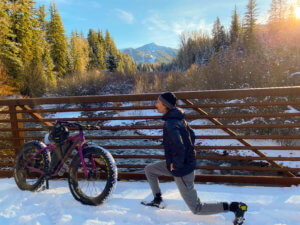
Reverse Lunge: The starting position for this skiing exercise is exactly the same as a walking lunge: Keeping a neutral spine, take a step backward—the same width as you would take moving forward in a walking lunge—with your right leg.
Once your knee almost touches the floor, push back up and forward to your starting position, trying to maintain level hip alignment throughout and keep your weight in your back leg. The big difference in this skiing exercise is that you’re using your front leg to stabilize your body.
Clock Lunge: For this skiing exercise, imagine you’re standing in the middle of a clock with the numbers 1-12 around the outside. Face forward so your chest points toward 12 o’clock; you’re going to have your chest and front stabilizer foot facing noon for the entirety of the exercise.
You want to be moving in a lateral plane of motion each time you push back to the start position. Your goal is to hit every clock number.
- Start with your right foot, using your left leg as a stabilizer and lunge forward to 12.
- Return to standing position and then lunge forward and slightly right to 1 and then step back.
- Continue lunging to each number on the clock until you’re stepping straight back to 6.
- Then, switch feet and finish the other numbers with your left foot, using your right leg as the stabilizer.
- A key with this skiing exercise is to have the back foot and knee pointing toward the front foot whenever the lunging leg is behind the stabilizing leg. That will help keep you in alignment.


Single-Leg Romanian Deadlift:
- Stand with your feet shoulder-width apart and knees slightly bent, and raise one leg off the floor. Flex the knee on your standing/support leg for about 15-20% to activate the glutes.
- Without changing the bend in your knee, keep your back naturally arched, bend (hinge) at your hips and lower your torso until it’s almost parallel to the floor
- Briefly pause at the bottom, then squeeze your glutes, thrust your hips forward and raise your torso back to the starting position.
Calf Raises:
For this skiing exercise, begin in a standing upright position in front of a counter or stable surface for support. At the same time, slowly raise both heels off the ground, then lower them down to the floor and repeat. Make sure to maintain an upright posture and keep your weight on the balls of your feet when you lift your heels.
Planks:
Begin this skiing exercise by lying on your front, propped up on your elbows. Engage your abdominal muscles and lift your hips and legs up into a plank position, keeping your elbows directly under your shoulders. Hold this position. Make sure to keep your back straight and maintain a gentle chin tuck during the exercise.
Walking Lunge with Rotation:
Begin this skiing exercise in a standing upright position with your feet shoulder-width apart and hands resting on your waist. Step forward with one leg, lowering your body into a lunge position and rotate your torso to the side, then carefully return to the starting position. Make sure not to let your knees collapse inward during the exercise.
Lateral Ski Jump:
Begin this skiing exercise in a standing upright position. Alternate taking small hops from one foot to the other, then continue increasing the distance of each hop until they are jumps, landing on each leg in a lunge position.
Make sure to keep your weight in your heels, focus on making your landings as soft as possible and maintain control during the exercise. Do not let your knee move forward past your toe as you land.
Lateral Step Down:
Begin this skiing exercise by standing on a platform or step with one leg hanging off the edge. Maintaining an upright position, bend at your knee and hip, slowly lowering your foot to the ground, then return up to the starting position and repeat.
Make sure not to let your trunk bend forward or your knee collapse inward as you lower your foot to the ground. If this skiing exercise is too easy, stand on a balance disc or Bosu ball to increase the intensity.
Lunge Alternative: Bulgarian Split Squat
Begin this skiing exercise in a wide staggered stance position with your back foot resting on a bench. Bend your front knee, lowering your body into a lunge position, then return to standing and repeat.
Make sure to keep your abdominals tight, and do not let your knee move forward past your toe or collapse inward during the exercise.
Hip Clocks:
Begin this skiing exercise by standing, with your feet together. Lift one foot off the ground and do a single-leg squat. Bend at the hip with your trunk leaning forward. Bend equally in your hip and knee, reaching forward with the opposite foot and tapping the heel of your foot on the ground. Return to an upright position.
Repeat, reaching the opposite foot to the side and tapping the inner portion of your foot on the ground. Return to the upright position.
Repeat the single-leg squat, reaching directly behind you and tapping your toes on the ground. Return to the upright position and repeat.
Keep your back in a neutral position, hinging at your hips during the squatting movement. Keep your hip, knee and ankle on the stance limb in alignment. The weight on your foot should remain centered on your midfoot throughout the squatting movement to ensure a strong base of support through the foot.
Repeat all of these skiing exercises until you complete the prescribed number of repetitions and sets you set for yourself. I recommend 10-15 reps with light or no weight and 6-8 with moderate to heavy weight, with 3 sets on each leg.
And remember, if you experience any pain or something that doesn’t feel right while performing ski conditioning, adjust the exercise or stop what you’re doing right away.
Certainly, leg strength is important for skiing. What else is important in terms of training for someone who wants to be in shape for the ski season?
Core strength, static and dynamic standing balance and cardiovascular endurance are all important for skiing and riding safely. Leg, arm, back and neck flexibility and conditioning are also important for seeing what’s going on around you, dealing with the changing terrain and when you fall. When people try to save themselves from a fall, they sometimes get hurt because they don’t have enough flexibility.
Muscle fatigue in your core, upper body and legs can alter the skiing stance as well and change how the body parts work together on the snow. There is strong evidence that fatigue and lack of knee stability cause the most injuries in skiing, and specifically, ACL injuries top the list.
What are your recommendations for visitors coming from lower altitudes who may not ski more than a few weeks per year?
Cardiovascular and strength training before your trip can help quite a bit. Arriving in Aspen and allowing a few days to acclimate to the altitude before hitting the slopes is not always realistic, so I recommend increasing water intake and sleep, and avoiding alcohol the first few days of your trip.
The Rehabilitation and Sports Medicine’s Physical Therapy department sees a high volume of injuries in people due to limited preseason training via the core skiing exercises, as well as not being acclimated to the altitude and elements. That’s especially true for visitors who only ski a week or two a year.
Please remember that any preseason ski conditioning is better than none and will reduce the risk of injury and make your ski season a much more enjoyable experience.
Is there a skiing exercise training regimen or program you can recommend for someone looking to get in shape for their ski trip or the season?
Winter sports-focused conditioning three or four days per week for the 4-6 weeks prior to your first day on the snow is ideal, whether you’re a visitor here for a one-week trip with your family or a local getting ready for the season. But as I said above, any preseason conditioning will help your skiing or snowboarding.
Begin with a warm-up before any workout: a stationary bike, walking, elliptical, or some other activity that gets your heart rate up and your muscles in motion.
The best leg-strength skiing exercises for ski and snowboard training are single-leg movements or exercises focusing on the eccentric or lowering portion of a motion (see exercises above). The down phase of a squat or lowering from a step, for instance.
High repetition of the various ski exercises you’re doing is important, as skiing and snowboarding involve quick and repetitive turns. Some of our summer and shoulder season sports, including hiking, biking and climbing are excellent cross-training for skiing. If something is hurting, it’s important to modify the exercise or skip it completely.
I recommend 30 minutes of cardio activity 3-4 times a week. Pick something you enjoy, walking, swimming, running, biking or jumping jacks. The best cardio workout is one you are willing to do.
Also, you can reduce delayed onset muscle soreness (DOMS) by finishing a skiing exercise routine with a stretch, foam roll or Theragun use.
What about local gyms and their ski conditioning and exercise programs?
Local gyms offer training. Ajax Fitness, Jean Robert’s Gym in Aspen, Willits and Glenwood, TAC Fitness in Basalt, the Aspen and Snowmass Rec Centers’ conditioning coaches or classes at the Red Brick in Aspen are some great examples of the many places you can go for conditioning.
As a physical therapist, do you see many injuries that might have been avoided with a good ski conditioning program?
As a physical therapist and ski patroller, every ski season it is common to see lower extremity injuries (knee, hip, ankle) due to poor stability, impaired balance, decreased strength and low endurance.
This can turn what should be a small muscle strain into a devastating ligament tear or broken bone. Although skiing will always have some risk of injury, we can significantly reduce that risk by putting some preseason work in and performing needle-moving skiing exercises.
Finally, if you are having any pain or are recovering from an injury, I highly recommend coming in for skilled physical therapy at one of our locations in Aspen, Snowmass Village or Basalt. You may be able to receive treatment without a physician’s referral, depending on your insurance coverage, so it’s worth checking out.
If you have any questions, please call me at the Rehabilitation and Sports Medicine department at Aspen Valley Health: 970-544-1177.
Jack Michael PT, DPT
To get fully prepared for the next Ski Season check out our Ski Preparation & Safety Guide.