Sign up for the Newsletter to receive the latest News & Events from Aspen Valley Health.
Aspen Valley Health is available 24/7 to provide you with the expert care that you need!
Phone:
970-925-1120Get In Touch:
Send us a messageDirectory
View DirectoryAddress:
Aspen Valley Health
0401 Castle Creek Road
Aspen, CO 81611
For many patients, persistent upper GI symptoms go unexplained for far too long. Chronic heartburn, difficulty swallowing, unexplained stomach pain: these are not things you should simply learn to live with. An upper endoscopy is often the procedure that finally provides real answers, and at Aspen Valley Health (AVH), patients throughout the Roaring Fork Valley can access that level of expert diagnostic care right here at home.

An upper endoscopy—clinically referred to as an esophagogastroduodenoscopy (EGD)—is a minimally invasive procedure that allows your surgeon to examine the lining of your esophagus, stomach and the upper portion of your small intestine.
A small, flexible camera is guided gently through the mouth, giving your care team a direct, real-time view of your upper digestive tract.
Unlike a colonoscopy, which focuses on the lower GI system, an upper endoscopy is the primary tool for investigating the source of symptoms that originate in the throat, chest or upper abdomen.
An upper endoscopy procedure is not purely diagnostic, either. If your surgeon identifies tissue that warrants further examination, a biopsy can be taken during the same procedure.
For patients who have spent months managing GI symptoms without a clear explanation, an endoscopy is frequently where that changes.
There are two core factors that are typically at play in determining whether an upper endoscopy procedure is the right call: existing symptoms and family/genetic history. We’ll break each of them down next.

Upper GI symptoms vary widely, but certain patterns are worth taking seriously, particularly when they are persistent, worsening or have not responded to standard treatment.
Talk to your provider at AVH about the benefits of an endoscopy procedure if you are experiencing any of the following:
These symptoms are not always indicators of something serious, but they deserve a real evaluation rather than ongoing symptom management that never gets to the root of the problem.
Surgical Specialists | Medical Center | Aspen
401 Castle Creek Road
Aspen, CO 81611
8:30 am-5:00 pm
Please fax referrals to our office.
Surgical Specialists | Medical Center | Aspen
401 Castle Creek Road
Aspen, CO 81611
Medical History and Risk FactorsEven without active symptoms, certain medical histories may lead your provider to recommend an endoscopy procedure as part of your ongoing care.
These include a personal or family history of Barrett’s esophagus, esophageal cancer or stomach cancer, long-term Gastroesophageal Reflux Disease (GERD) that has never been formally evaluated with imaging, a prior H. pylori infection or a history of upper GI surgery that warrants periodic monitoring.
If any of these apply to you, discuss your risk with your primary care provider.
Ongoing Surveillance for Known ConditionsFor patients already living with a diagnosed upper GI condition, an endoscopy is not a one-time event.
Routine surveillance endoscopies are a standard part of managing Barrett’s esophagus, monitoring healing after ulcer treatment and tracking the status of previously identified abnormalities.
AVH is the right place to establish and maintain that ongoing relationship, with a team that knows your history and your care goals.

An upper endoscopy procedure can provide your care team with a clear, detailed view of your upper digestive tract that imaging alone cannot offer.
Conditions commonly identified through endoscopy include:
What can be Treated During and After an EndoscopySome conditions can be detected and addressed during the endoscopy procedure itself.
Tissue biopsies can be collected for pathological analysis, esophageal strictures can be dilated and small polyps or obstructions can be removed, all in the same appointment.
Other conditions, once identified, are managed through follow-up surgical intervention. This is where AVH offers something that sets it apart from most facilities in the region.
Conditions such as hiatal hernias, GERD that has not responded to conservative treatment and certain esophageal disorders can be treated surgically using the most advanced robotic technology available, by the same provider who performed your endoscopy procedure.
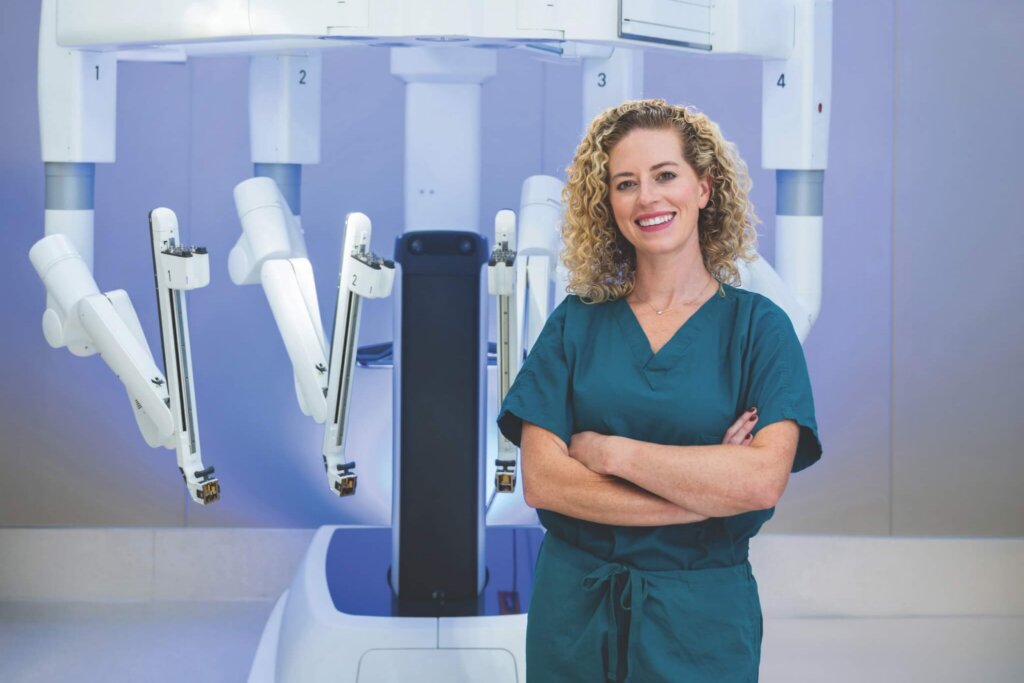
Surgical Treatment, Where and When You Need itDr. Alexandra Kovar is the only fellowship-trained foregut robotic surgeon in the Roaring Fork Valley. AVH is home to the most advanced robotic and endoscopic technology currently on the market.
For patients whose endoscopy leads to a surgical recommendation, that surgery can happen right here, with the provider who already knows your case.
No referrals to distant facilities. No starting over with a new team. Continuity of care matters to us because it matters to you.

Patients in Aspen, Basalt, Carbondale and Glenwood Springs deserve access to diagnostic and surgical GI care that does not require a trip to Denver or Salt Lake City. Here is what makes AVH the right choice for your endoscopy procedure.
Diagnostic Depth, All in One Place — From standard upper endoscopy to Bravo pH monitoring, esophageal manometry and EndoFLIP, AVH offers a comprehensive suite of upper GI diagnostic tools under one roof. You receive a complete evaluation, not a starting point that leads to referrals elsewhere.
Diagnosis and Surgery With the Same Provider — At most facilities, a gastroenterologist performs your endoscopy procedure and refers you to a separate surgical team if treatment is needed. At AVH, your endoscopy procedure and any necessary surgical intervention are handled by the same board-certified surgeon. That continuity has a real impact on the quality and coordination of your care.
The Most Advanced Robotic Technology Available — AVH is equipped with the most advanced robotic surgical platform currently on the market. Dr. Alexandra Kovar, who is the only fellowship-trained robotic surgeon in the Roaring Fork Valley, uses this technology to perform complex GI procedures with precision that rivals the largest medical centers in the country, right here in your community.
A Team that Stays with You — From your initial consultation through your endoscopy procedure and recovery, your AVH care team remains actively involved in your progress. There are no hand-offs to unfamiliar providers. The people who start your care are the people who see it through.

Most patients are referred to AVH for an endoscopy procedure by their primary care physician or an existing GI provider. If your provider has recommended an upper endoscopy procedure or if you have been experiencing persistent upper GI symptoms, ask for a referral to the AVH Surgical Specialists team and we will take it from there.
Note: You will need a referral to schedule an endoscopy procedure with AVH. We do this to prioritize your safety and ensure that we collect critical medical information from you prior to your procedure. Before we schedule, our Prior Authorization Team will reach out to the clinic and to you if there are any issues with insurance coverage.

One of the most common sources of anxiety around an upper endoscopy procedure is the prep. The good news is that for most patients, it is straightforward.
There is no bowel prep kit, no multi-day dietary protocol and no prescription to pick up in advance. Compared to other GI procedures, the preparation for an upper endoscopy procedure is minimal.
Within ten days of your endoscopy procedure, a member of our pre-op nursing team will reach out by phone and text to walk you through arrival logistics, anesthesia details and any questions you may have.
If you have not heard from the team by the Wednesday before your procedure, please call us at 970.544.1311.
Endoscopy procedure times are approximate. Same-day scheduling adjustments do occasionally happen, so keep your phone nearby on the day of your appointment. If there are any changes to your arrival time, your care team will contact you directly.
An upper endoscopy is one of the more straightforward procedures in GI medicine. For the large majority of patients, any apprehension they feel beforehand is far greater than anything they experience during the procedure itself.
Patients sometimes worry about gagging or discomfort during an upper endoscopy, but sedation is administered before the scope is introduced, so you will be relaxed and unaware from the start. The procedure is well tolerated and quick.
Once you are sedated, your surgeon will carefully advance the endoscope through your esophagus, stomach and into the upper small intestine, examining the tissue lining along the way. If anything warrants a closer look, a small tissue sample can be collected at that moment for pathological analysis.
A standard upper endoscopy procedure typically takes between 15 and 30 minutes, though the full time at the hospital, including preparation and recovery, is closer to three hours.
Throughout the procedure, advanced AI-assisted imaging technology supports your surgeon in detecting abnormalities with greater precision, ensuring that subtle findings are not overlooked.

Most endoscopy patients feel well enough to leave within an hour of the procedure completion, though you will need your designated driver.
A mild sore throat is the most common side effect of an upper endoscopy and typically resolves within a day or two.
Some patients experience minor bloating or a feeling of fullness from the air used during the endoscopy procedure.
Most people return to their regular diet and routine by the following day, with no restrictions unless your care team advises otherwise.
While complications from an upper endoscopy procedure are uncommon, please reach out to your care team at AVH if you experience any of the following in the days after your procedure:
Call our office during business hours at 970.544.1200. The office is closed on weekends, so if you experience an urgent concern outside of business hours, we urge you to seek emergency care.
Your Aspen Valley Health team does not consider their role finished when your endoscopy procedure ends.
From scheduling through recovery and results, you have a consistent point of contact and a team that is invested in what comes next for your health. For you, for life.

If you have been managing upper GI symptoms without a clear explanation, it is time to change that. The AVH team is ready to see you; with the technology, expertise and time to get it right. To reach our Surgical Specialists team, please call us at 970.544.1200.
Our promise, For You. For Life., means providing the care and resources that will help you flourish during every season of life. Read our blog here and discover your healthy journey.